
 ARGOMENTI
IN EVIDENZA
salone di genova open skiff optimist vela paralimpica class 40 vele d'epoca windsurf regate protagonist sailgp 52 super series
VENDÉE GLOBE
Vendée Globe: crown duels
redazione
Three key duels of differing intensities prevail on the race track of the Vendée Globe this morning but only in the head-to-head tussle for the overall lead has there been no change in supremacy overnight.
Racing in sunshine and 20kts of SW’ly winds it is the battle between François Gabart and Armel Le Cléac’h which remains closest with Le Cléac’h seemingly poised to move ahead, 1.9 miles behind the leader on Macif and sailing faster by between one and two knots.
With Jean-Pierre Dick still nicely in touch at 99 miles behind in third on Virbac-Paprec 3, the leading twosome have a relatively straighforward speed race to the Australia South ice gate, around 300 miles in front of them, but the duel for fourth place between Switzerland’s Bernard Stamm and Briton Alex Thomson is subject to a much more tactical range of options. But this duo will share the same disappointment that their margin to the leader is now opened to close to 300 miles.
Stamm v Thomson, Advantage Thomson
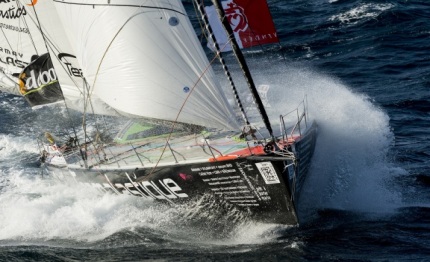
Yesterday, whilst also dealing with a small catalogue of repairs, Stamm dropped off the back of the low pressure system which the leaders are still riding and into lighter winds. Since then he has had to take Cheminées Poujoulat to the east, mirroring the course which Thomson has been on since the last gate. Thomson’s Swiss rival has suffered through the night with only moderate breezes at time, periodically very slow, and so the Hugo Boss skipper has broken back through to fourth, 12 miles ahead of Stamm.
The key, medium term, for Alex Thomson is that by tomorrow morning he should be hooked into a fast moving depression before Stamm whose track at times is now north of east, effectively sailing away from the next gate as he searches for that same low.
Golding v Le Cam, Advantage Le Cam
Thomson’s compatriot Mike Golding, who has been ahead of his French rival Jean Le Cam for more than two weeks, has had to cede sixth place as he works further to the north of Le Cam, an investment which he hopes will give him a long term benefit as he targets the same low as Hugo Boss. Le Cam is more than 30 miles ahead this morning whilst Golding has been slowed to five knots.
In contrast conditions are finally excellent for Spain’s Javier Sanso on Acciona 100% Eco Powered to make miles on the trio in front of him. With Dominique Wavre virtually stuck to the Indian Ocean making just 1.2kts this morning, Sanso is catching fast at 17kts and soon perhaps the Swiss skipper will be closer to Sanso than he will to Le Cam and Golding, his companions since the Cape Verde Islands.
Arnaud Boissieres (Akena Vérandas) checked in through the Crozet gate last night at 2000hrs UTC whilst Alessandro Di Benedetto (Team Plastique) crossed the longitude of the Cape of Good Hope at 1730hrs UTC.
Photo Credit: Vincent Curutchet/DPPI/Vendée Globe
13/12/2012 11:33:00 © riproduzione riservata
Tweet
ARTICOLICORRELATI
I PIU' LETTIDELLA SETTIMANA
Trans Benaco, i Melges 32 dominano la 40ª edizione: Wilma firma il successo del quarantennale
A conquistare il titolo della 40ª Trans Benaco Cruise Race è stato Wilma (GER 193), Melges 32 armato dal Circolo Vela Torri e timonato da Carlo Cavagna, capace di completare le due prove con un tempo complessivo di 7 ore, 30 minuti e 22 secondi
Il Mondiale OpenSkiff entra nel vivo: a Calasetta una flotta ricca di medaglie
Tra i 166 registrati diversi protagonisti delle ultime edizioni iridate. Grande attesa per la squadra italiana, oltre che per gli atleti della Lega Navale Italiana Sezione Sulcis, organizzatore dell'evento
Si conclude a Capodimonte il Trofeo Optimist Italia
Il vento detta i tempi di questa ultima giornata e la terza tappa si chiude con un totale di sei prove svolte
Trofeo Optimist Italia: Pasquini e Pucci partono al comando sul Lago di Bolsena
Nella Divisione A il primo leader della classifica è Massimo Pasquini (LNI Ostia), autore di una serie molto regolare (8-5-1); nella Divisione B Valerio Pucci (Circolo Nautico Marina di Carrara) ha preso il comando grazie ai parziali di 1-1-5
52 SUPER SERIES: Trinity rompe il dominio ma Sled allunga a Lanzarote
Il comitato di regata ha sfruttato una breve finestra meteorologica per far disputare una regata intensa, nella quale Trinity Racing ha conquistato il primo successo stagionale, mentre Sled ha consolidato la leadership dell'evento
Golden Globe Race: in sei danno forfait prima della partenza
A 47 giorni dal via del 6/9, ben sei skipper hanno rinunciato al sogno di prendere parte alla regata più estrema della vela oceanica, mentre altri sei stanno attraversando l'Atlantico cercando di completare in tempo la qualificazione obbligatoria
Optimist, Bolsena: seconda giornata da incorniciare al Trofeo Optimist Italia
Trofeo Optimist Italia Kinder Joy of Moving: Tabacco conquista il primato nella Divisione A e Valerio Pucci resta in testa nella Divisione B
Iniziato il Mondiale Openskiff a Calasetta: 3 prove con maestrale
Tre regate, vento da nord ovest tra i 14 e i 17 nodi, un’onda mai complicata e soprattutto divertente. Il Campionato del Mondo OpenSkiff 2026 è iniziato nel migliore dei modi a Calasetta
SailGp: luci e ombre a Portsmouth per Red Bull Italy
Roma studia l'organizzazione inglese per prepararsi al SailGP di Ostia 2027. Presente a Portsmouth Alessandro Onorato, Assessore ai Grandi Eventi, Sport, Turismo e Moda di Roma Capitale
52 Superseries: a Marina Rubicón Paprec vince al fotofinish
La terza tappa delle 52 SUPER SERIES si decide tra Ocs, manovre millimetriche, penalità e vento forte: Platoon domina tutte e due le prove, Alkedo brilla e poi paga per la falsa partenza, Sled perde contatto, Paprec vince per la costanza di risultati